
©Gaul’s Legacy Tours

US Memorial Diekirch

Where? 25, Avenue de la Gare, L-9233 Diekirch

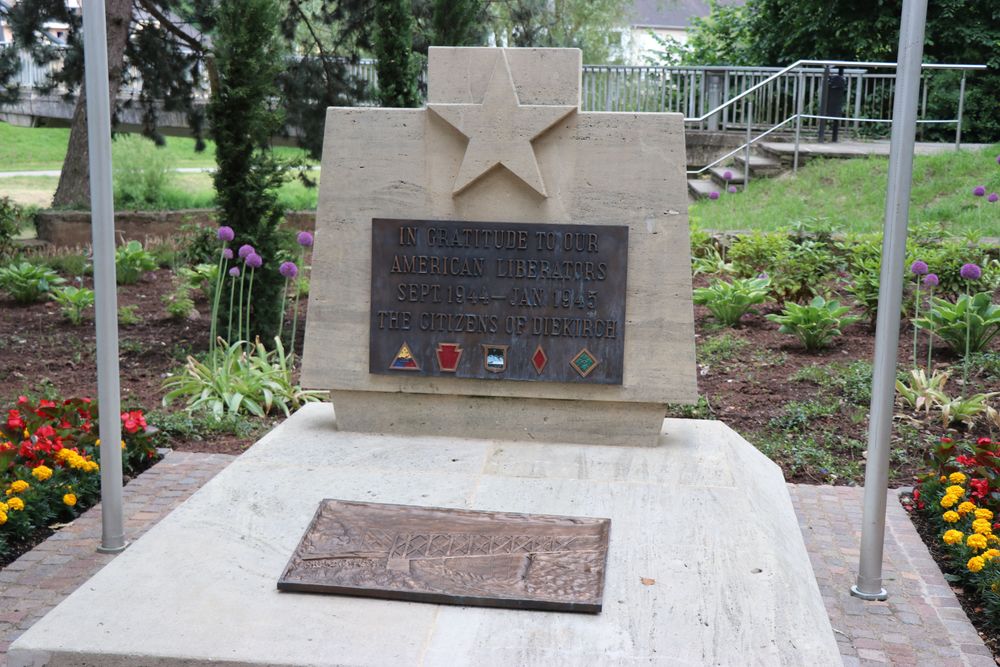
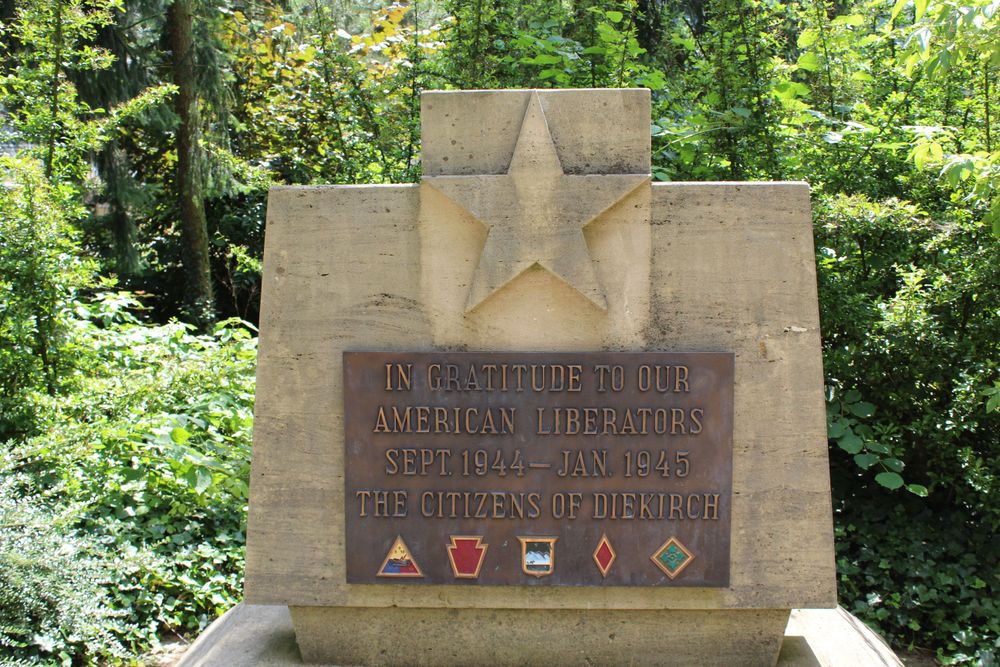
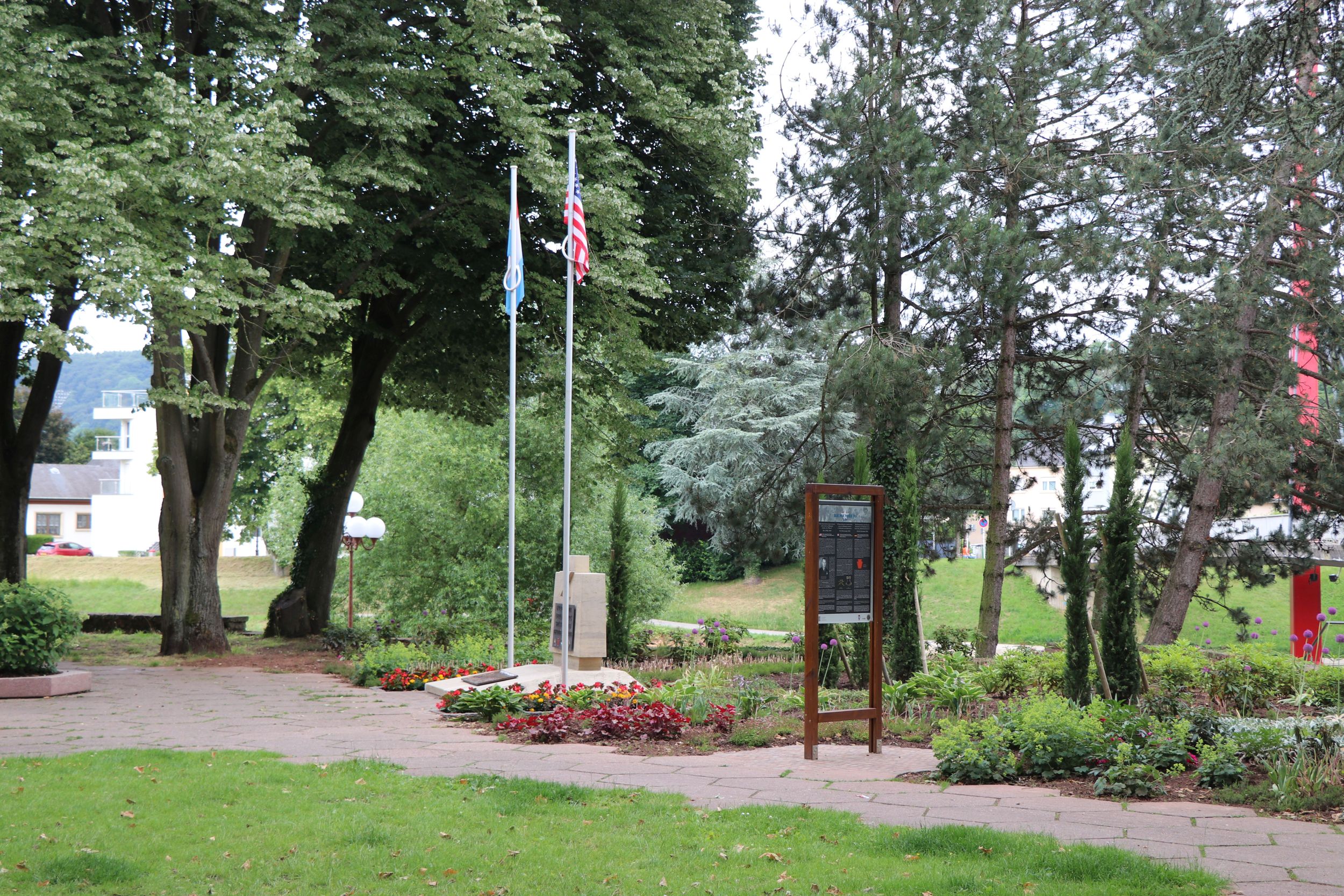
The US Memorial located in the municipal parc of Diekirch river remembers a number of US units that were present in and around the city, September 1944 – February 1945.

The US Memorial of Diekirch is located on the banks of the Sûre next to the pedestrian bridge that spans the river. Inaugurated in 1984 on the initiative of the Diekirch National Museum of Military History on the occasion of the 40th anniversary of the liberation of Luxembourg and the Battle of the Bulge, it pays tribute to all those US military units that were stationed, fought and transitted through Diekirch and surrounding areas from September 1944 to February 1945. 

A bronze plaque at the bottom of the pedestrial of the monument shows the former railroad bridge, replaced later by the present concrete foot bridge. 

Units of the 5th US Armored Division liberated the town for the first time via that railroad bridge. The same bridge was used during the night of December 19/20, 1944 by approximately 6.000 civilians to flee the town in great haste face to the approaching enemy. Finally, the partially destroyed bridge was used in 1945 by units of the 5th US Infantry Division during the “Sauer river” crossing operations. It was repaired to be re-used as again a railroad bridge until 1962.
Contact

Address: US Memorial Diekirch
25, Avenue de la Gare
L-9233 Diekirch
Show on map

More sites

©Alfonso Salgueiro
Tour suggestion
Remembering the Second World War
Duration: 2 days
Given Luxembourg’s location and place in history, it is home to many memorial sites with a connection to the dark days of World War II.
Find out more
©Visit Éislek
Church Saints-Côme-et-Damien
The parish church of Sts Côme et Damien in Clervaux, built in 1910/1911 in the Rhenish-Romanesque style, impresses with its striking dome above the altar and its majestic twin towers with melodic chimes.
Find out more
Përmeshaff – Estate ruins
Përmeshaff, a historic site near Kaundorf, traces its roots to 1195. Over the centuries, it evolved into a religious centre, attracting pilgrims to its chapel and healing springs. Despite enduring a devastating fire in 1936, recent archaeological efforts have unveiled layers of its rich history, highlighting significance of Përmeshaff as a cultural landmark.
Find out more
Anti-tank gun 43
At the Houfëls viewpoint, the imposing presence of two World War II relics awaits visitors.
Find out more
©Visit Éislek
Museum of the Battle of the Bulge Wiltz
Discover the moving history of the "martyr town" during the Battle of the Bulge in the interactive museum in Wiltz. Experience history up close in the beautiful Wiltz Castle.
Find out more
©Visit Éislek
St. Cunegonde Chapel
The St. Cunegonde Chapel in Heiderscheidergrund, a noteworthy example of 19th-century ecclesiastical historicist architecture in Luxembourg, features a neo-Gothic design, late Gothic sculptures, 18th-century statues, and glass paintings, embodying the country's historical and national consciousness as the oldest Kunigundis shrine.
Find out more
©Paul Dostert
A stumbling sill in memory of the Jewish community
Discover a poignant tribute to Ettelbruck's vibrant pre-war Jewish community, as you walk through the historic heart of the town and stumble upon the "Stumbling sill."
Find out more
Saint-Roch church Insenborn
Discover the neo-Gothic splendour of the Insenborn church, built according to plans by architect Biver in 1861.
Find out more
©Visit Éislek
Centre Cinqfontaines
The small village of Cinqfontaines (Five Wells), not far from Troisvierges, is home to a former monastery built at the beginning of the 20th century. In 1941 it was confiscated by the Nazis who used it as a place of internment for Jews from Luxembourg.
Find out more